Justice Considers Return to Governor’s Race as He, Morrisey Tout West Virginia’s Economic Future at Business Summit
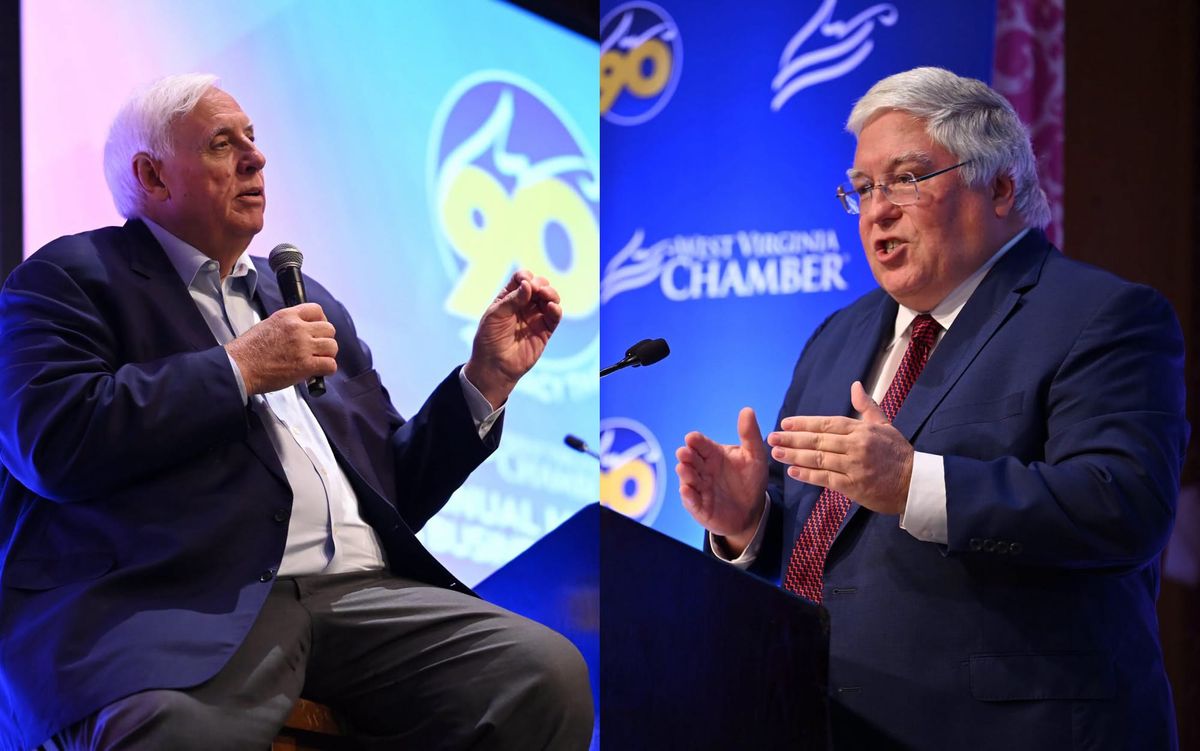
WHITE SULPHUR SPRINGS, W.Va. — U.S. Sen. Jim Justice says he is seriously considering another run for governor in 2028, adding a new political backdrop to a West Virginia Business Summit where both Justice and Gov. Patrick Morrisey laid out their views on the state's economic future.
Justice, who served two terms as governor before being elected to the U.S. Senate in 2024, confirmed Thursday during an appearance on MetroNews “Talkline” from The Greenbrier that he is “100 percent” considering seeking the governor's office again.
Justice said his consideration centers on whether West Virginia has maintained the economic momentum he believes was built during his eight years as governor.
He also said he does not intend to leave the question hanging indefinitely and expects to make a decision relatively soon.
Morrisey, who succeeded Justice as governor in January 2025, declined to engage in the potential 2028 matchup when asked about it Thursday, instead saying his focus remains on delivering economic results during his current term.
The political discussion unfolded as both Republicans appeared separately before business leaders gathered for the West Virginia Chamber of Commerce's 90th Annual Meeting and Business Summit.
Justice's speech focused heavily on economic development, energy and the need for West Virginia to aggressively compete with other states for major projects.
“You got to be hungry like a pit bull and go get it,” Justice told attendees while discussing economic development. “Compete. Compete with other states.”
Justice repeatedly returned to energy as the foundation for future growth, arguing that West Virginia's coal, natural gas and other resources position the state to compete for manufacturing, technology and other large-scale investments.
“There's three ways for this country to prosper in ways like you can't imagine, and it's energy, energy and energy,” Justice said. “West Virginia is right dead in the bullseye.”
He also addressed the rapid growth of data centers and artificial intelligence infrastructure, an issue that has become one of the largest economic development debates in West Virginia.
Justice said the state should not allow concerns surrounding data centers to cause it to miss major economic opportunities, but said companies coming to West Virginia also have a responsibility to address impacts on communities.
He specifically pointed to electricity bills, water, noise and environmental concerns as issues that should be addressed as projects move forward.
“We don't want to be left out,” Justice said. “There's a way to coexist.”
Morrisey's Business Summit address came with several major economic development announcements.
The governor announced more than $81 billion in new projected private investment, primarily connected to two large data center developments.
NScale received state High Impact Data Center certification for a first phase projected at approximately $69.2 billion. The project is expected to require about 2 gigawatts of electricity and support approximately 4,375 construction jobs and 645 permanent positions.
Starwood Digital Ventures also received certification for a planned $12 billion project in Mason County that could require approximately 2.16 gigawatts of power and support about 1,500 jobs.
Morrisey said both companies will be responsible for their project-related infrastructure costs rather than shifting those costs to existing West Virginia electric customers.
The governor said the announcements bring private-sector investment announced since October 2025 to approximately $96 billion, with more than 19,000 projected jobs associated with projects announced during that period.
“We are pursuing every lead aggressively, moving at the speed of business, and putting West Virginia's abundant energy resources to work right here at home,” Morrisey said.
Morrisey also highlighted a $13 million expansion by life sciences company Randox in Jefferson County that is expected to create 100 jobs, along with Appalachian Power's acquisition of the Longview Power Plant near Morgantown and plans for additional power generation in West Virginia.
The two speeches shared considerable common ground.
Both Justice and Morrisey argued that West Virginia's energy resources can become the foundation for a new generation of economic growth. Both also emphasized the need to attract large employers while protecting existing residents from infrastructure costs associated with new projects.
Their approaches, however, carried different emphasis.
Justice repeatedly pointed back to the state's need to actively pursue companies and compete aggressively for projects, invoking economic development successes from his years as governor.
Morrisey focused on investments announced during his administration and his preference for strengthening infrastructure and economic fundamentals while limiting the amount of project costs borne by taxpayers and ratepayers.
The possibility of a Justice candidacy adds another layer to those differences.
West Virginia's Constitution prevents a governor who has served two consecutive terms from serving during the immediately following term. Because Justice left office when Morrisey began his current term in 2025, the restriction would not prevent Justice from seeking the office again in 2028.
Justice's current U.S. Senate term runs through 2030.
For now, no 2028 campaign has been announced.
But with Justice publicly acknowledging that another gubernatorial run is under serious consideration, speeches about West Virginia's economic direction at this year's Business Summit also offered an early glimpse at an argument voters could hear much more about over the next two years.