John Beilein Honored With Induction Into WVU Sports Hall of Fame
MORGANTOWN, W.Va. — Nearly two decades after leading West Virginia University men's basketball through one of the most memorable stretches in program history, former head coach John Beilein has earned a permanent place among the Mountaineers' athletic greats.
Beilein was inducted into the WVU Sports Hall of Fame on Saturday, October 10, recognizing a five-season tenure that included an NCAA Elite Eight appearance, back-to-back Sweet 16 trips and a National Invitation Tournament championship.
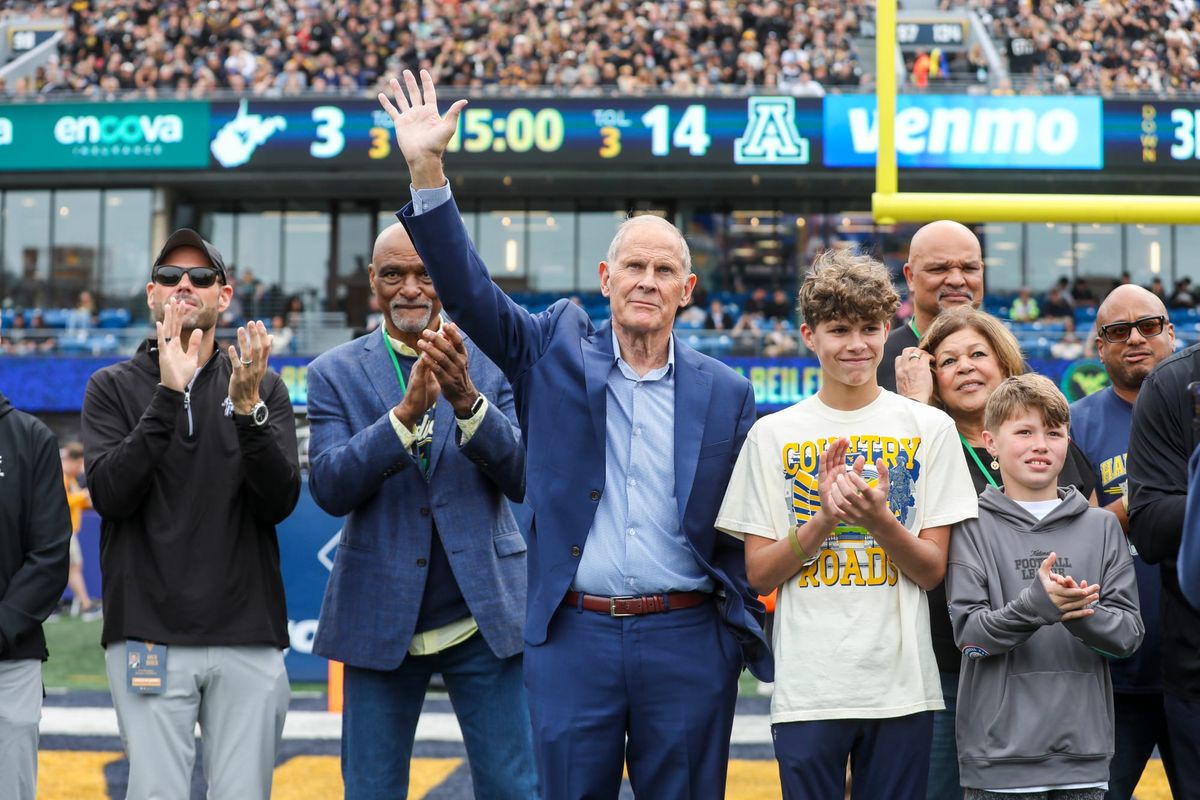
The ceremony, held at the Caperton Indoor Practice Facility in Morgantown, welcomed seven new members into the university's Sports Hall of Fame as part of its 36th induction class. The inductees were also recognized during Saturday's football game against Arizona.
For Beilein, the recognition celebrated a chapter that helped reshape West Virginia basketball and produced some of the program's most recognizable players and unforgettable tournament moments.
Named WVU's head coach in April 2002, Beilein inherited a program coming off an 8-20 season. Over the next five seasons, he guided the Mountaineers to a 104-60 record and four consecutive postseason appearances.
His signature achievement came during the 2004-05 season, when West Virginia made an unexpected run through the NCAA Tournament.
Led by players including Kevin Pittsnogle and Mike Gansey, the Mountaineers advanced to the Elite Eight for the first time in 42 years. Along the way, West Virginia defeated Creighton, Wake Forest and Texas Tech before falling to Louisville in overtime in the regional championship.
That postseason followed a remarkable appearance in the Big East Tournament championship game, helping reestablish WVU as a nationally competitive basketball program.
The Mountaineers defeated a school-record eight ranked opponents during the 2004-05 season and finished No. 12 in the final USA Today/ESPN coaches poll.
The momentum continued in 2006, when Beilein led West Virginia to another Sweet 16 appearance and a 22-win season. It marked the program's first consecutive trips to the NCAA Tournament regionals since 1959 and 1960.
His final season in Morgantown produced another memorable championship run.
After narrowly missing the 2007 NCAA Tournament, West Virginia earned a No. 1 seed in the NIT and advanced to Madison Square Garden.
The Mountaineers defeated Mississippi State on a last-second shot by Darris Nichols before beating Clemson in the championship game to secure the program's second NIT title and first since 1942.
Beilein's influence extended beyond postseason victories. His offensive system, emphasis on fundamentals and ability to develop players helped establish a distinctive identity for West Virginia basketball.
Pittsnogle became the program's first men's basketball All-American since 1972, while Gansey emerged as one of the nation's top players. Johannes Herber also earned national recognition for his academic achievements, including Academic All-American of the Year honors in 2006.
Following the 2007 season, Beilein departed West Virginia to become head coach at the University of Michigan, where he continued building his reputation as one of college basketball's most accomplished coaches.
At Michigan, he guided the Wolverines to national championship game appearances in 2013 and 2018, nine NCAA Tournament appearances and four Big Ten regular-season or tournament championships. He became the winningest coach in Michigan men's basketball history.
His collegiate coaching career ultimately spanned 41 seasons, producing 829 victories across multiple divisions. He also coached professionally with the Cleveland Cavaliers and later served in a player development role with the Detroit Pistons.
Beilein was inducted into the National Collegiate Basketball Hall of Fame in 2022.
Despite his achievements elsewhere, his time at West Virginia remains an important part of his coaching legacy. The 2005 Elite Eight team, consecutive Sweet 16 appearances and 2007 NIT championship helped introduce a new generation of Mountaineer fans to postseason basketball success.
His induction into the WVU Sports Hall of Fame recognizes not only the victories, but also the lasting place those teams and their coach hold in the university's athletic history.
Beilein was joined by six other inductees in the 2026 class, each recognized for significant contributions to Mountaineer athletics.
Kadeisha Buchanan, Women's Soccer: One of the most decorated athletes in WVU history, Buchanan became the university's first Hermann Trophy winner in 2016. The three-time first-team All-American helped lead the Mountaineers to the 2016 NCAA national championship game and later won an Olympic gold medal representing Canada.
Dennis Fowlkes, Football: A standout linebacker from 1979 through 1982, Fowlkes recorded 459 career tackles, ranking among the school's all-time defensive leaders. He helped lead West Virginia to victories in the 1981 Peach Bowl and later played four seasons in the NFL.
Bria Holmes, Women's Basketball: A three-time unanimous All-Big 12 First Team selection, Holmes finished her WVU career with 2,001 points. She was selected 11th overall in the 2016 WNBA Draft by the Atlanta Dream and went on to play five seasons professionally.
Alex Kasich, Cross Country and Track & Field: An All-American distance runner who competed for WVU from 1972 through 1976, Kasich won the 1975 USTFF cross country national championship and established multiple school records. He later competed internationally and became an influential figure in professional road racing.
Ashley Lawrence, Women's Soccer: A three-time All-American and four-time All-Big 12 First Team selection, Lawrence helped lead WVU to the 2016 NCAA national championship game. She later won Olympic gold with Canada and built a successful international professional soccer career.
Craig Turnbull, Wrestling: The winningest wrestling coach in WVU history, Turnbull recorded 287 victories during his 35-year tenure from 1979 through 2014. He coached three wrestlers to a combined five individual NCAA national championships and helped establish West Virginia as a nationally competitive wrestling program.
The 2026 induction class brings the total number of individuals honored in the WVU Sports Hall of Fame to 250 since its establishment in 1991.