U.S. Supreme Court Upholds West Virginia's Save Women's Sports Act in Landmark 6-3 Decision
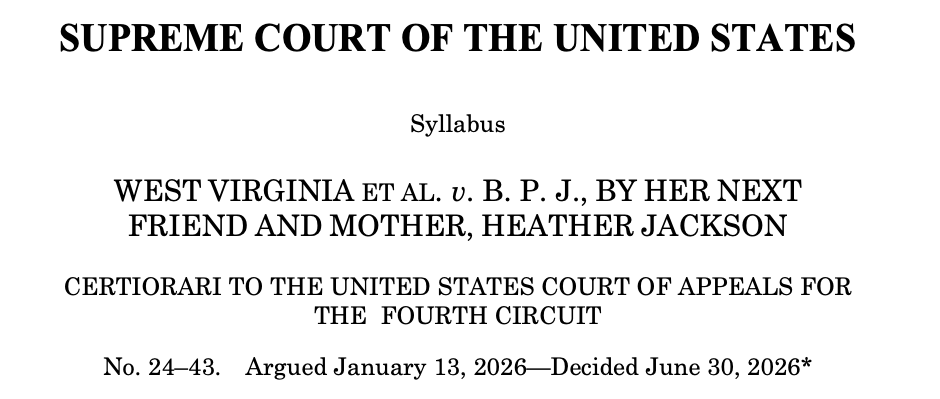
CLARKSBURG, W.Va. — The United States Supreme Court ruled Tuesday that West Virginia may continue enforcing its Save Women's Sports Act, concluding that states may determine eligibility for girls' and women's school sports based on biological sex.
The 6-3 decision represents one of the most significant rulings involving transgender athletes and school athletics to reach the nation's highest court, establishing nationwide precedent for similar laws adopted across the country.
Justice Brett Kavanaugh authored the majority opinion, joined by Chief Justice John Roberts and Justices Clarence Thomas, Samuel Alito, Neil Gorsuch and Amy Coney Barrett. Justices Sonia Sotomayor, Elena Kagan and Ketanji Brown Jackson dissented in part.
At the center of the case was West Virginia's Save Women's Sports Act, passed by the West Virginia Legislature in 2021. The law requires participation on girls' and women's athletic teams to be based on biological sex.
The legal challenge was brought by Bridgeport student Becky Pepper-Jackson, identified in court filings as B.P.J. Pepper-Jackson, who was born male and identifies as female, challenged the law after seeking to compete on girls' cross-country and track and field teams, arguing the law violated both Title IX and the Equal Protection Clause of the Fourteenth Amendment.
While the case worked its way through the federal courts, Pepper-Jackson continued competing under court orders and recently won the West Virginia Class AAA girls' state championship in the shot put. The Supreme Court referenced that result while outlining the history of the case.
Court: Title IX Allows Separate Teams Based on Biological Sex
In its opinion, the Supreme Court concluded that Title IX — the landmark federal law enacted in 1972 prohibiting sex discrimination in education — allows schools to maintain separate athletic teams for biological males and biological females.
Writing for the majority, Justice Kavanaugh stated that "Title IX transformed American sports and American life" by expanding opportunities for female athletes. The Court concluded that preserving separate women's sports based on biological sex remains consistent with both Title IX and the Constitution.
The Court also rejected claims that West Virginia's law violated the Equal Protection Clause, finding that the state's interests in athletic fairness, safety and preserving equal opportunities for female athletes justified the law. The opinion further concluded that courts are not required to evaluate transgender athletes on an individual basis before states establish eligibility standards for school sports.
Dissent Focused on Equal Protection
Justice Sonia Sotomayor, joined by Justices Elena Kagan and Ketanji Brown Jackson, agreed in part and dissented in part.
The dissent argued that the Court gave states too much latitude to exclude transgender athletes and maintained that broader constitutional protections should require a closer examination of laws affecting transgender students. The dissent also questioned whether scientific evidence regarding athletic advantages is sufficiently settled to support categorical policies.
The majority responded that legislatures, rather than courts, are better positioned to evaluate evolving medical and scientific evidence when establishing policies governing school athletics.
National Impact
Although the dispute began in West Virginia, the decision carries implications well beyond the Mountain State.
According to the Court, 27 states have enacted laws preserving girls' and women's sports based on biological sex. Tuesday's ruling establishes that those laws are permissible under both Title IX and the Equal Protection Clause, providing nationwide guidance for similar policies.
Following the decision, West Virginia Attorney General J.B. McCuskey called the ruling "a monumental victory for every female athlete who has ever competed, or dreamed of competing, on a fair and safe playing field," adding that the decision affirms states' authority to designate sports teams based on biological sex.
The Supreme Court reversed lower court rulings against West Virginia and Idaho and returned both cases for further proceedings consistent with its opinion, effectively allowing West Virginia's Save Women's Sports Act to remain in effect.
Read the Opinion
The full opinion issued by the United States Supreme Court in West Virginia v. B.P.J. is available on the Court's official website for those interested in reviewing the decision in its entirety.